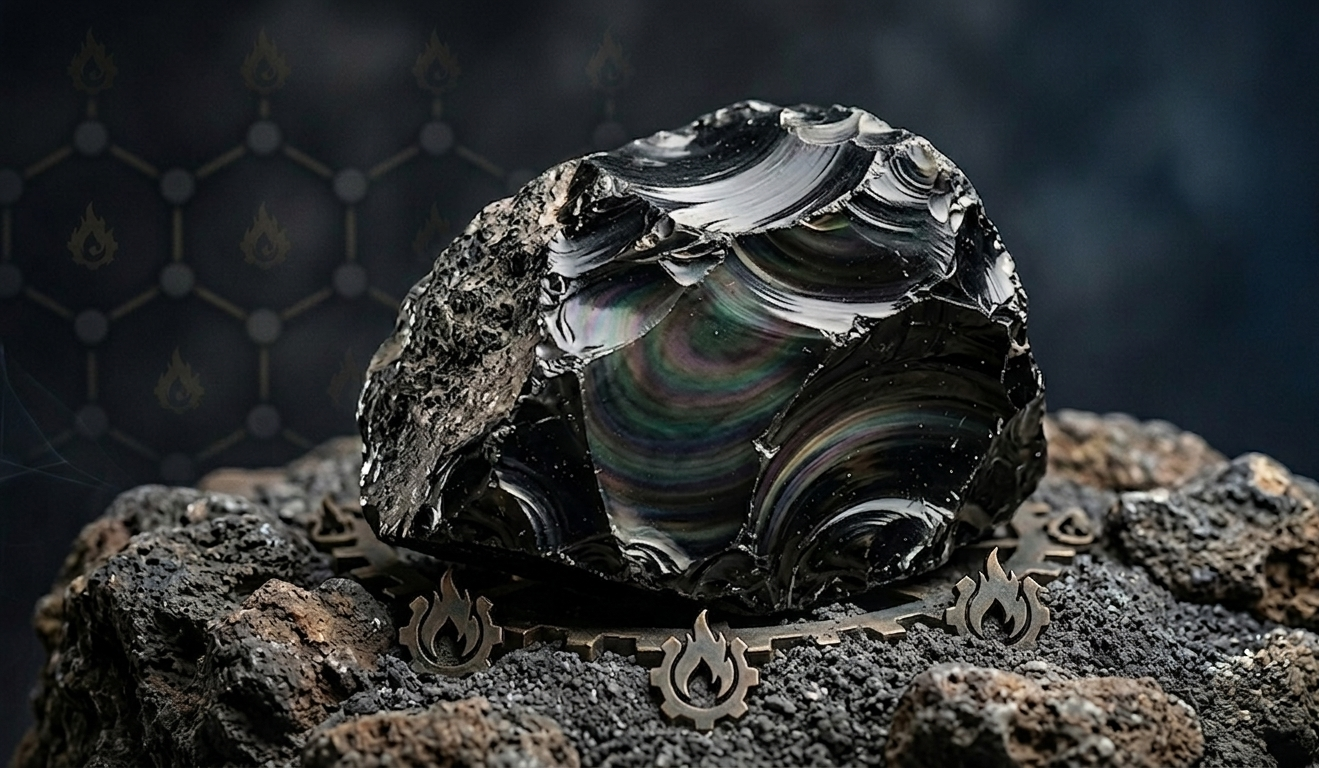
An introduction to what glass is, how it behaves, and a few curiosities. Is it a solid or a liquid? Is it a crystal? Is it a cat?
Glass
Glass has been one of the great mysteries of science. Is it a solid or a liquid? Why does it not crystallize when it goes from a liquid state to a solid one?
For the first question, we do have an answer: it is an amorphous solid. For practical purposes, it behaves like a solid, although it does not have the internal structure of a crystal.
And although we do not have a full answer to the second question—at least I do not—there is something we do know:
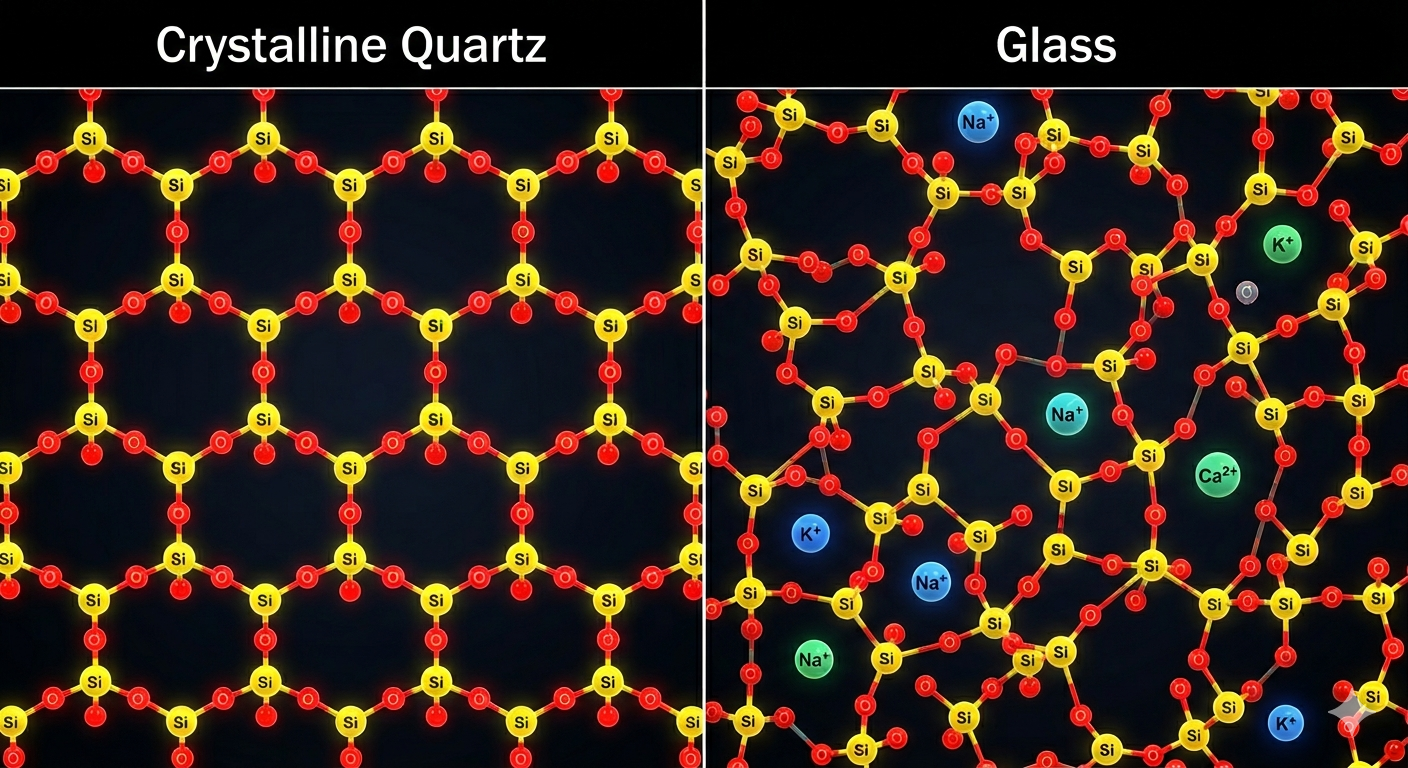
Glass is not a crystal. Crystals are solids with ordered, periodic particles. Glass, by contrast, is a structure made of silicon-based compounds and disordered oxides: amorphous.
We can say that glass forms when a liquid cools quickly and does not have enough time to crystallize. As this happens, its internal structure becomes locked in place and settles into a chaotic, amorphous arrangement. It is a material outside thermodynamic equilibrium, in a metastable state: its structure is not the one with the lowest possible energy (a crystal), but its high viscosity prevents it from evolving toward that state.
Using the brilliant analogy from EveryAcctNameIsTaken in this Reddit thread:
It is like a cat lying in a horribly uncomfortable position, with its legs stretched out in strange directions and its body twisted into an impossible posture. Surely it would be more comfortable curled up into a little ball, or something like that.
The curled-up position is like a crystalline structure, such as diamond: it has less energy and is more comfortable. The strange stretched-out position has more energy. The cat could be far more comfortable than that. Glass is like the cat in that horrible posture: it knows it looks ridiculous and uncomfortable, but it is not going to move. It seems as if nothing prevents it from going to a more pleasant and ordered state, and yet it still does not.
It is a type of ceramic material (made through heat treatment). It can be synthetic, which is the kind we normally work with, but it can also occur naturally in obsidian, which forms when volcanic lava with a high silica content cools quickly and does not have time to form crystals.
The temperature range at which silica melts is approximately 2000°C. Other compounds, such as sodium carbonate, are added to lower the melting temperature to around 1500°C. The working temperature in lampworking is not the same as the melting temperature: we only need to heat the glass enough to make it workable… not drinkable. That is usually somewhere between 600°C and 1200°C.
From all of the above, we can highlight:
- There is no single fixed melting temperature, but rather a range, and it depends on the type of glass and its internal composition.
- The goal when heating glass is not necessarily to melt it completely, but to control its viscosity so it can be worked.
As an amorphous solid, glass at room temperature has an extremely high viscosity, and there is some debate over whether, in theory, it could slowly drip or flow at room temperature. What is certain is that it would take thousands of millions of years for that to become noticeable.
This is unlike pitch, which really is a liquid, although a very viscous one, and it drops one drop roughly every ten years, as shown by the pitch drop experiment. You can even watch it in real time here.
Glass transition
It is the process by which glass goes from being rigid and solid to soft and moldable. It is not a melting point like that of a crystal. There is no exact point, but rather a range.
Thermal gradient
It is the difference in temperature within a piece. For example, the outside might be at 900°C while the inside is at 500°C. One area is hot and expands, while another is cold and does not expand in the same way. When the piece cools, those areas contract differently, generating internal stresses that can cause cracks and spontaneous breakage hours or even days later. That is why we always try to keep the temperature as even as possible throughout the piece. This is also why we use a kiln: to maintain a more uniform temperature throughout the piece and allow it to cool evenly.
COE
The Coefficient of Thermal Expansion measures how much glass expands and contracts when it is heated and cooled. This is why glasses with different COEs are not compatible.
The higher the value, the more it expands.
Types of glass, COE, and temperatures
| Type of glass | COE | Working temperature (°C) | Approx. Tg (°C) | Typical use |
|---|---|---|---|---|
| Soda-lime (Murano/Effetre) | 104 | 600–1200 | 500–550 | Flameworking (beads, figures) |
| Fusing glass (Bullseye) | 90 | 700–1000 | 500–600 | Kiln work (fusing, slumping) |
| Borosilicate (Pyrex) | 33 | 1000–1300 | 550–600 | Scientific work, borosilicate, pipes |
| Fused silica (Quartz) | ~0.5 | 1700–2000 | ~1200 | Optics, industry |
For two glasses to be compatible, COE is a necessary condition, but they also need:
- A compatible viscosity curve
- The same annealing range
- Chemical compatibility (proven in practice)